

Higher Resolution, more value for money
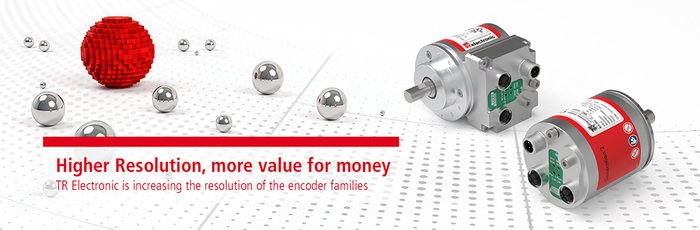
TR Electronic is increasing the resolution of the CE_582, CE_802, and CE_1102 encoder families from 15 bits to up to 18 bits per revolution.
At TR Electronic, we strive to build encoders that are not only robust but also as precise as possible. One of the most important parameters for this is resolution: It determines how many steps a mechanical revolution is divided into, and thus how finely the encoder can detect movement. While the standard for the CE_582, CE_802, and CE_1102 series was previously 15 bits per revolution—or 32,768 steps—these devices are now capable of resolving a single revolution with up to 18 bits—that is, 262,144 steps, an eightfold increase. This version has been available since September 1, 2026, at no additional cost.
The benefits of this upgrade are particularly evident in speed output. Speed is calculated from the change in position over a fixed cycle. For slow axes, only a small change in value occurs within this cycle. The encoder’s resolution limits therefore, how finely this change can be detected. The result is stepped speed values, which the controller interprets as speed fluctuations and responds to with changes in current and torque. Anyone who has ever tried to commission an electric axis slowly and smoothly is familiar with this challenge. With 18 bits, position quantization becomes 8 times finer—the speed output has noticeably higher resolution, and the axis runs more smoothly. A helpful comparison: If you divide a distance into millimeters instead of centimeters, you can detect small differences much more accurately due to the finer scale division.
This also improves other performance metrics: Reproducibility is now ± 0.002° (previous ± 0,01°),, and the linearity deviation is ± 0.01° instead of the previous ± 0.02°. For the user, this means greater performance at the same price and noticeably more freedom in project planning: It is no longer necessary to decide in advance whether 15 bits are sufficient or whether a higher resolution must be ordered to be on the safe side. The maximum resolution of 18 bits is already available in every device — even for subsequent optimizations of a system that are often not foreseeable at the design stage.
For existing customers, nothing changes with regard to their agreements. Devices delivered and specified to date continue to correspond exactly to the agreed-upon delivery condition, including parameterization with a lower resolution. Those who wish to use the additional bits can switch the resolution to the maximum available 18
bits using the appropriate parameterization tools—via the bus system, Industrial Ethernet, or the TR configuration software “TRWinProg.” No hardware modifications are required for this.
TR Electronic’s Generation 2 absolute encoders meet a wide range of technical requirements for the automation of motion processes in production and special-purpose machines, as well as in plant engineering. Based on the 58-mm industry standard, customers receive customized systems from the modular product range. Various shaft designs and a wide selection of interfaces make it easy to adapt the encoders to both the mechanical conditions and the desired control environment. For larger shafts, the 802 and 1102 series offer hollow through shafts up to 50 mm. When compactness is required, the trueabsolute multiturn encoders of the 362 series fit into small installation spaces while maintaining full resolution and precision.
Your benefits at a glance:
- Higher performance at the same price
- Higher resolution for smoother operation during speed control
- Better repeatability: ± 0.002°
- Improved linearity deviation ± 0.01°
- System optimization is possible even retroactively without replacing hardware.
- Order one version, take advantage of the full range.
All absolute encoders with 18-bit resolution from TR Electronic: https://www.tr-electronic.com/s/S027164
Press article including photograph